


Under pressure from Mercedes-Benz’s 6.3-liter 510-hp V8-powered ML63 AMG revealed at last September’s Frankfurt motor show, Porsche unleashed a new range-topping Cayenne Turbo S version the company claims out-accelerates its own new sports car, the Cayman S, from a standstill to 62 mph.

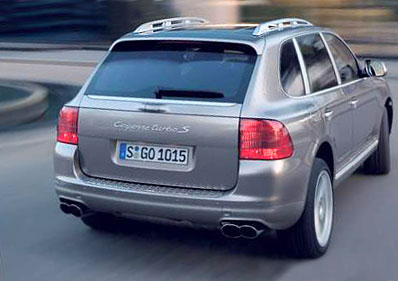 Unveiled at the Los Angeles show, this four-wheel-driver runs a more powerful version of the Cayenne Turbo’s twin-turbocharged 4.5-liter V8 engine, putting out 521 hp at 5500 rpm and 531 lb-ft of torque between 2750 and 3750 rpm.
That is a 71-hp and 71-lb-ft improvement on the standard Cayenne Turbo. It makes this new S the second most powerful road car Porsche has ever placed into production after the 5.7-liter, 605-hp V10 Carrera GT. It’s also enough to lower the big, 5200-pound SUV’s 0-to-62-mph time from 5.6 seconds to 5.2, as well as provide it with a 50-to-75-mph fifth-gear time of 5.4 seconds.
Top speed is limited to 168 mph, though the Turbo S comes standard with specially developed performance tires that are rated to 186 mph, indicating this new Porsche can charge beyond this speed when left to its own devices.
Among engine modifications are larger intercoolers housed within the front wheel arches and an increase in turbo boost pressure, which now peaks at 1.9 bar instead of the standard model’s 1.7 bar. Despite the power increase, Porsche officials say average fuel consumption remains the same as the Cayenne Turbo: 14.8 mpg.
The Cayenne Turbo S also gets a reworked suspension with recalibrated air springs that work in combination with a self-leveling feature to lower the SUV’s body at high speeds to improve stability. Inside the wheel arches are 20-inch alloys with 275/40-profile tires. The brake discs grow 30 millimeters in diameter at the front to 380 millimeters, and by 28 millimeters at the rear to 358 millimeters.
You will need to look hard to spot the Cayenne Turbo S. The only distinguishing features are its wheels, quad tailpipes and Turbo S badges.
© autoweek.com


